


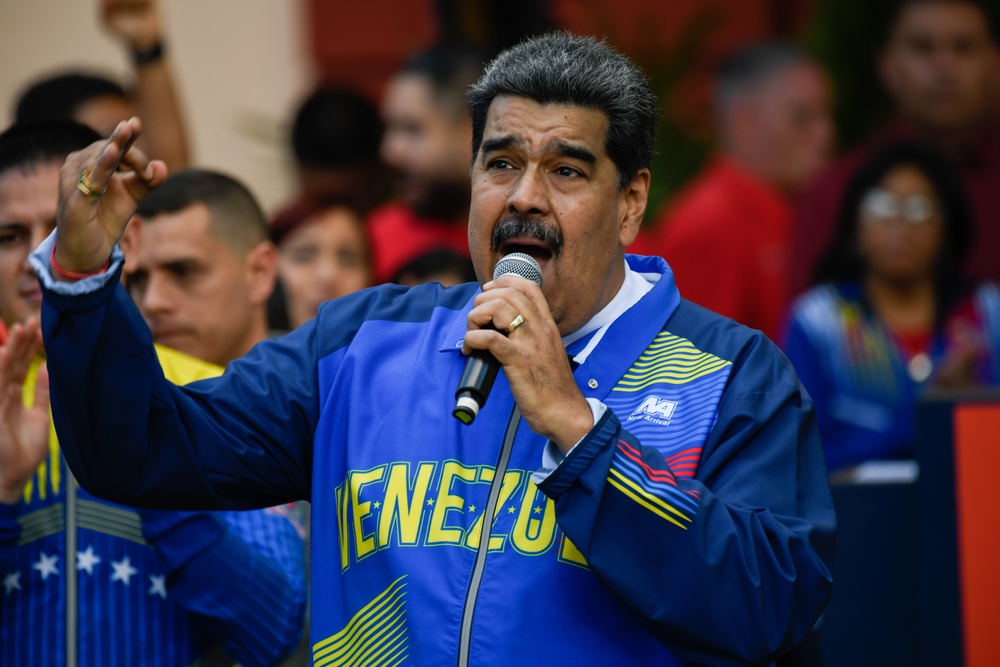
In a dramatic operation that stunned governments and observers worldwide, US forces arrested Venezuelan President Nicolás Maduro and his wife, Cilia Flores, in Caracas and flew them to New York to face criminal charges. The move marked one of the most aggressive US interventions in Latin America in decades.
Soon after the arrests, President Donald Trump announced that the United States would assume temporary control of Venezuela, saying Washington would oversee the country until a new leadership transition could be arranged.
“We are going to run the country until such time as we can do a safe, proper and judicious transition,” Trump said during a news conference at his Mar-a-Lago resort in Florida. “We can’t take a chance that somebody else takes over Venezuela who doesn’t have the good of the Venezuelan people in mind.”
Washington Claims Interim Control
Trump said the US would manage Venezuela with the help of a small leadership group, pointing to Secretary of State Marco Rubio, Defense Secretary Pete Hegseth, and Chairman of the Joint Chiefs of Staff General Dan Caine as key figures involved in the process. However, he offered few concrete details about how the interim administration would function.
At one point, Trump claimed that Venezuela’s vice president, Delcy Rodríguez, had been sworn in as Maduro’s successor and was willing to cooperate with US plans. Venezuelan authorities, however, made no announcement confirming that Rodríguez had taken office.
Trump framed the move as a necessary step after months of speculation about possible US military action against Venezuela. “We’re not afraid of boots on the ground,” he said, adding that American oil companies would be brought in to rebuild the country’s damaged energy infrastructure.
“We’re going to fix the oil infrastructure, spend billions of dollars, and start making money for the country,” Trump said. He also warned that the US was prepared to launch “a second and much larger attack” if circumstances demanded it.
Legal Justification and Political Fallout
Secretary of State Marco Rubio rejected claims that the operation required congressional approval, describing it instead as a law enforcement action supported by the military.
“This was not the kind of mission you can do congressional notification on,” Rubio said. He pointed to Maduro’s 2020 US indictment, saying the Venezuelan leader was “not the legitimate president” and had been a fugitive from American justice with a $50 million reward on his head.
Trump suggested Congress had not been informed in advance because of concerns the plans could leak.
The announcement drew swift criticism from Democrats in Washington. Senator Mark Warner warned that the operation set a dangerous precedent. “If the United States claims the right to invade and capture foreign leaders it accuses of crimes, what stops China from making the same claim over Taiwan or Russia doing the same in Ukraine?” he said.
Warner also accused the administration of hypocrisy, noting Trump’s earlier pardon of former Honduran President Juan Orlando Hernández, who had been convicted on drug trafficking charges in the US. “You can’t justify invasion in one case while issuing a pardon in another,” he said.
Support, Risks, and an Uncertain Future
Republicans largely backed the move. Senator Roger Wicker, chairman of the Senate Armed Services Committee, praised Trump for what he called a successful mission and said the arrest capped months of efforts to weaken criminal networks linked to Maduro’s government.
“The Venezuelan people must now act swiftly to put their country back on a path to peace and prosperity,” Wicker said.
Still, analysts warned that the fallout could be severe. Daniel DePetris of the Defense Priorities think tank said the operation could trigger major instability inside Venezuela, including military fractures, the rise of criminal groups, or even civil war.
“Whether this leads to positive change or something far worse remains to be seen,” DePetris said, adding that none of the likely scenarios would be good for regional stability or US interests.
He also questioned the shifting justifications used by the Trump administration, which have ranged from fighting drug trafficking and reclaiming oil resources to restoring democracy.
“In reality, Venezuela is not a regional super-threat,” DePetris said. “It’s a bankrupt state whose economy has collapsed over the past decade.”
